
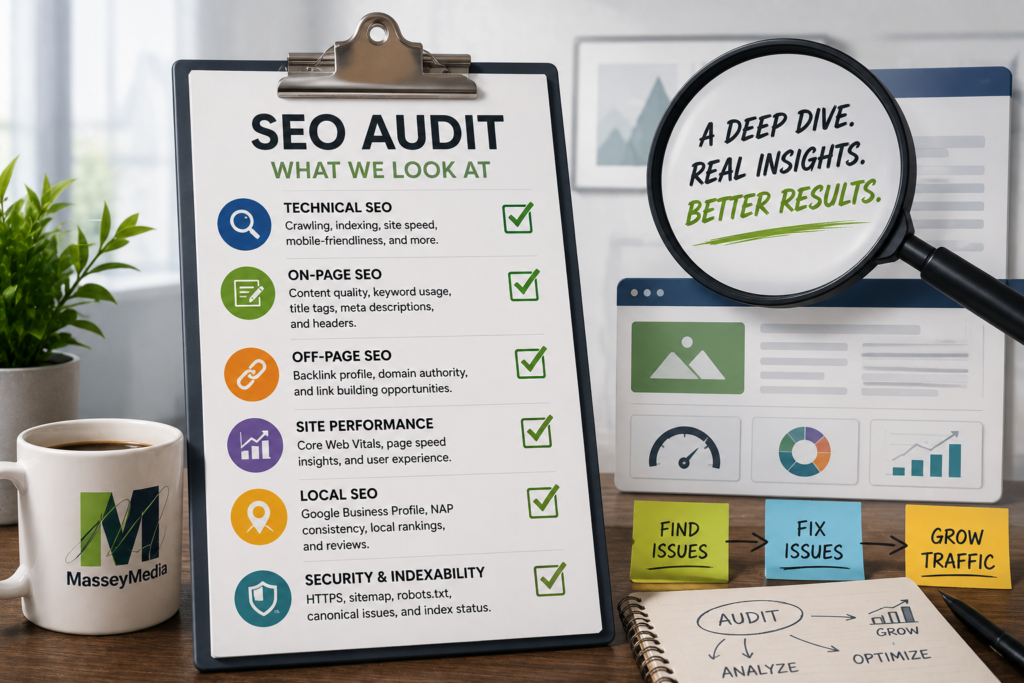
If you’ve ever been handed a 40-page PDF from an SEO company and had no idea what it meant, you’re not alone. SEO audits have a reputation for being dense, jargon-heavy documents that feel more impressive than useful. They don’t have to be.
A well-done SEO audit is actually one of the most practical tools a small business owner can have. It tells you exactly where you are, what’s hurting you, and what needs to happen first to start moving in the right direction. After 25 years of auditing websites for businesses across Lufkin, Nacogdoches, and all of East Texas, here’s what we look at — and what each piece actually means for your business. If you’re still wondering whether you even need one, start with our overview of what local SEO is and why it matters.
Technical SEO: Is Your Website Built to Be Found?
Before Google can rank your website, it has to be able to find and read it. Technical SEO is the foundation that everything else sits on. Problems here can quietly kill your rankings even if your content is excellent. You can check some of these issues yourself using Google Search Console, which is free and provides direct insight into how Google sees your site.
Crawlability
Google uses automated programs called “crawlers” to scan websites. If your site has broken pages, misconfigured settings, or redirects that loop back on themselves, Google’s crawlers may not be indexing your pages correctly — meaning those pages essentially don’t exist in search results.
Site Speed
Google measures how fast your pages load and factors that directly into rankings. We check your load time on both desktop and mobile using Google’s PageSpeed Insights, identify what’s slowing the site down — large images, heavy code, slow hosting — and prioritize the fixes with the most impact. Our full post on how website speed affects your rankings goes deep on this topic.
Mobile Responsiveness
Google now uses your mobile site as the primary version it evaluates. If your website doesn’t look and function correctly on a phone, you’re at a serious disadvantage regardless of how good your desktop version is. A professionally designed and built website handles this automatically.
SSL Security
Your website address should start with “https” not “http.” That “s” indicates your site has an SSL certificate, which encrypts data between your site and your visitors. Google explicitly penalizes sites without SSL, and most browsers now warn users away from them with “Not Secure” labels.
On-Page SEO: What Does Your Website Tell Google?
Once we know Google can access your site, we look at what it finds when it gets there. On-page SEO is about making sure every page communicates its purpose clearly — to both search engines and real people.
Title Tags and Meta Descriptions
These are the words that appear in search results before someone clicks on your link. They need to include your target keywords naturally, describe what the page is about, and be compelling enough that someone actually wants to click. We check every page for missing, duplicate, or poorly written titles and descriptions.
Header Structure
Your H1, H2, and H3 headings are like a table of contents for Google. They signal what the page covers and how it’s organized. A well-structured page makes it easy for Google to understand your content — and easier for your visitors to read it.
Keyword Targeting
We analyze what keywords each page is currently targeting (or failing to target), how well those keywords match what your customers are actually searching for, and where there are gaps or missed opportunities. For East Texas businesses, this includes specific local intent terms — things like “digital marketing Lufkin TX” or “website design Angelina County.”
Content Quality and Length
Thin content — pages with very little text — gives Google almost nothing to evaluate. We look at whether your pages have enough substance to establish topical authority, and whether the writing actually answers the questions your prospective customers are asking. A consistent business blog is one of the best ways to build that depth over time.
Local SEO: Can Nearby Customers Find You?
For most East Texas small businesses, local SEO is where the biggest opportunities live — and where the most common problems hide.
Google Business Profile
We review every element of your Google Business Profile: completeness, accuracy, photo quantity and quality, review count and recency, response rate, and whether your business categories are set correctly. This one profile has an outsized effect on your local search visibility.
NAP Consistency
We check your Name, Address, and Phone number across dozens of online directories — Google, Yelp, Facebook, Yellow Pages, Bing, Apple Maps, and more — to identify inconsistencies. Even small differences (like “Suite 100” vs. “Ste. 100”) can undermine your local rankings. Our full breakdown of NAP consistency and why it matters is worth reading before your audit.
Local Citations
Citations are mentions of your business across the web, even without a link. We check whether you’re listed in the major directories that Google treats as trust signals for local businesses, and identify where new listings would strengthen your local presence.
Backlink Profile: Who’s Vouching for You?
Backlinks — links from other websites pointing to yours — are one of the oldest and most enduring ranking factors in SEO. We audit both the quantity and quality of your existing backlinks. A handful of links from respected local sources (the Chamber of Commerce, industry associations, local news) carries far more weight than dozens of links from low-quality directories. Moz’s guide to backlinks explains the underlying logic well.
We also check for toxic backlinks — links from spammy or irrelevant sites that can actually hurt your rankings. These are more common than most people realize, especially if a previous agency used questionable tactics.
Competitor Analysis: What Are They Doing That You’re Not?
A great SEO audit doesn’t just look inward. We compare your website and online presence against your top local competitors — the businesses currently outranking you for the searches that matter most to your bottom line. Knowing exactly what they’re doing gives us a clear roadmap for what it takes to pass them. Our post on why your competitor ranks higher covers the most common reasons in plain language.
What Happens After the Audit?
The audit is the map. After that comes the work — prioritized, step-by-step improvements that address your most critical issues first and build toward long-term rankings that hold up over time. Our local SEO service handles all of it on an ongoing basis.
MasseyMedia offers a free SEO audit for East Texas small businesses. No fluff, no 40-page report you’ll never understand — just a clear, plain-English breakdown of where you stand and what we’d do about it. Schedule your free consultation or call us in Lufkin to get started.
Matt Massey
Matt Massey is the owner and lead developer at MasseyMedia. Matt earned a Bachelor’s in Business Management and another in Marketing from the University of Utah. Matt started MasseyMedia during college to pursue his college degree and has been growing the company for over 25+ years.
As a seasoned IT executive, I have spearheaded numerous transformative projects that have streamlined operations, enhanced organizational capabilities, and driven sustainable growth. My expertise spans designing and implementing robust web-based information systems, managing comprehensive IT functions, and leading diverse teams to deliver projects that exceed expectations.
At MasseyMedia, Inc., I have been the driving force behind over 400 successful website launches and numerous IT development projects. My approach integrates strategic planning with hands-on leadership to diversify product offerings and expand business horizons. From introducing advanced hosting solutions to integrating cutting-edge network infrastructure, my focus has always been on leveraging technology to solve complex business challenges.
My career is defined by a passion for technology, a commitment to excellence, and a relentless pursuit of innovative solutions that drive efficiency and competitiveness. I am eager to connect with like-minded professionals and organizations looking for a leader to transform their IT landscapes and guide them through the complexities of modern technology.