You’ve probably clicked on a search result, waited five seconds for the page to load, and just hit the back button. Your customers are doing the exact same thing to your website — and Google is watching.
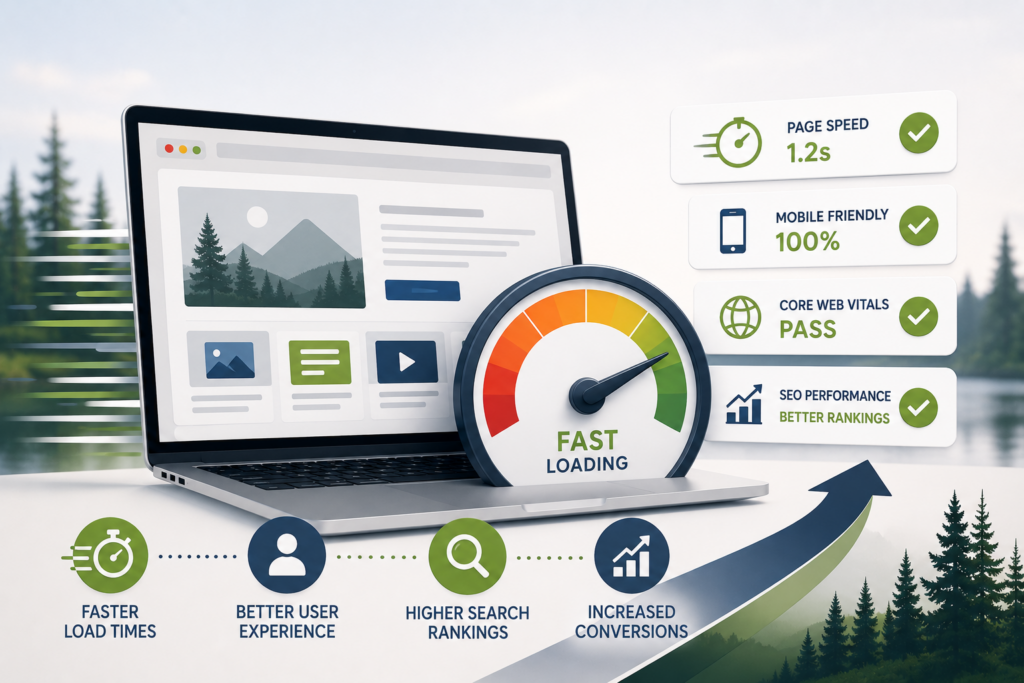
Page speed has been an official Google ranking factor since 2010 for desktop and since 2018 for mobile. That means a slow website doesn’t just frustrate visitors; it actively hurts your position in search results. For small businesses in Lufkin, Nacogdoches, and across East Texas competing for local search traffic, a fast website isn’t a luxury — it’s a competitive requirement. If you’re not sure where you stand overall, a professional SEO audit will surface speed issues alongside everything else affecting your rankings.
What “Website Speed” Actually Means
Speed isn’t just about how fast the page loads in total. Google measures a handful of specific metrics grouped under what they call Core Web Vitals. You don’t need to memorize the technical names, but it helps to understand what they’re measuring:
How Quickly Your Page Starts Loading (LCP)
This measures how long it takes for the biggest visible element on your page — usually a hero image or main headline — to appear on screen. Google wants this to happen within 2.5 seconds. If it takes longer, your score drops and your rankings can too.
How Quickly Your Page Becomes Interactive (FID/INP)
This is the time between when a visitor first tries to interact with your page — clicking a button, tapping a link — and when the browser actually responds. A page that looks loaded but doesn’t respond to clicks feels broken. Google penalizes it accordingly.
How Much Your Page Shifts Around While Loading (CLS)
You’ve seen this: you try to tap a button and suddenly an image loads above it and you tap something completely different. That jarring shift is called Cumulative Layout Shift, and it’s one of Google’s pet peeves. Pages with significant layout shift are scored poorly even if they load quickly otherwise.
Why Speed Matters Even More for Mobile Searches
The majority of local searches — someone in Lufkin looking for a contractor, a restaurant, a dentist, an IT company — happen on a mobile phone. Mobile networks are often slower than home Wi-Fi, which makes page speed even more critical. Google’s mobile-first indexing means the mobile version of your site is the primary version Google evaluates for rankings.
If your website was built more than a few years ago without mobile performance in mind, there’s a real chance it’s dragging your rankings down every single day — even if it looks fine on your desktop computer. This is one of the key reasons your competitors may be outranking you.
What Causes a Slow Website?
Most speed problems trace back to a handful of common culprits:
Unoptimized Images
Images are typically the single biggest contributor to slow load times. A photo taken with a modern smartphone can be 4-6 megabytes. A website that loads a dozen of those images uncompressed will crawl. Proper image optimization — compressing files, serving them in modern formats, and lazy-loading images below the fold — can dramatically cut load time on its own.
Cheap or Shared Hosting
Your web host is the physical infrastructure your website runs on. Budget shared hosting puts dozens or hundreds of websites on the same server, and when one of them gets traffic, everyone slows down. The few dollars a month you save on hosting can cost you far more in lost search rankings and bounced visitors. MasseyMedia’s managed website hosting is built specifically for WordPress performance.
Outdated or Poorly Coded Themes and Plugins
Many WordPress websites accumulate plugins the way a garage accumulates old tools — there’s always a good reason at the time, but eventually the clutter creates problems. Too many active plugins, or poorly coded ones, force your website to load far more code than it needs to. The result is a heavier, slower page. Regular website maintenance keeps this under control.
No Caching or CDN
Caching saves a “snapshot” of your page so it doesn’t have to rebuild from scratch every time someone visits. A Content Delivery Network (CDN) stores copies of your site on servers around the world, so visitors are served from the location closest to them. Both are now standard practice for professionally managed websites.
How Much Does Speed Actually Affect Rankings?
The short answer: significantly for local search. In head-to-head comparisons of businesses with similar content and authority, the faster website consistently ranks higher. And the conversion impact is just as real — research from Google shows that as page load time increases from one second to three seconds, the probability that a visitor bounces increases by 32%. At five seconds, that number jumps to 90%.
For an East Texas small business trying to convert local searchers into phone calls and customers, those numbers represent real revenue walking out the door.
How to Find Out if Speed Is Hurting You
Google offers a free tool called PageSpeed Insights that scores your website on mobile and desktop. You can enter your URL and get a score from 0 to 100 — anything below 50 on mobile is a serious concern. Even a score in the 50-70 range likely means there are speed improvements that could lift your rankings.
That said, the score is just the diagnosis. The fixes require knowing which specific issues to address and in what order — and some of them, like switching hosting or restructuring how your site loads, aren’t DIY projects. Understanding how long it takes for SEO improvements to show results will help set realistic expectations once you start making changes.
What MasseyMedia Does About It
Speed optimization is a standard part of every website we build and every SEO engagement we take on. We host websites on fast, managed servers specifically configured for WordPress performance. We compress and properly format every image. We audit and trim plugin bloat. We implement caching and CDN configurations that make pages load as fast as the underlying content allows.
For businesses that already have a website but suspect speed is a problem, we offer a free technical audit that includes your speed scores, a breakdown of what’s causing the slowdown, and a plain-language explanation of what it would take to fix it.
If your website is slow, your competitors are benefiting from it every single day. Schedule your free audit and let’s change that.
Matt Massey
Matt Massey is the owner and lead developer at MasseyMedia. Matt earned a Bachelor’s in Business Management and another in Marketing from the University of Utah. Matt started MasseyMedia during college to pursue his college degree and has been growing the company for over 25+ years.
As a seasoned IT executive, I have spearheaded numerous transformative projects that have streamlined operations, enhanced organizational capabilities, and driven sustainable growth. My expertise spans designing and implementing robust web-based information systems, managing comprehensive IT functions, and leading diverse teams to deliver projects that exceed expectations.
At MasseyMedia, Inc., I have been the driving force behind over 400 successful website launches and numerous IT development projects. My approach integrates strategic planning with hands-on leadership to diversify product offerings and expand business horizons. From introducing advanced hosting solutions to integrating cutting-edge network infrastructure, my focus has always been on leveraging technology to solve complex business challenges.
My career is defined by a passion for technology, a commitment to excellence, and a relentless pursuit of innovative solutions that drive efficiency and competitiveness. I am eager to connect with like-minded professionals and organizations looking for a leader to transform their IT landscapes and guide them through the complexities of modern technology.