
1. Write What People Around Here Are Searching For (Blog Traffic for Small Business Starts Here)
Most small business blogs fail at the first step. The owner writes about what interests the owner. “5 Trends in Our Industry” gets zero searches because nobody wakes up in Lufkin and types that. Flip it. Write down the ten questions customers actually ask you on the phone. “How much does this cost?” “How long does it take?” “Do I need a permit?” Each of those is a post, and each one has real people typing it into Google right now. Then localize it. “How Much Does a Metal Roof Cost” is a fight against the entire internet. “How Much Does a Metal Roof Cost in East Texas” is a fight you can win, because the search volume is smaller and so is the competition. Smaller and winnable beats big and hopeless every time.2. Build Every Post Around One Keyword You Can Actually Rank For
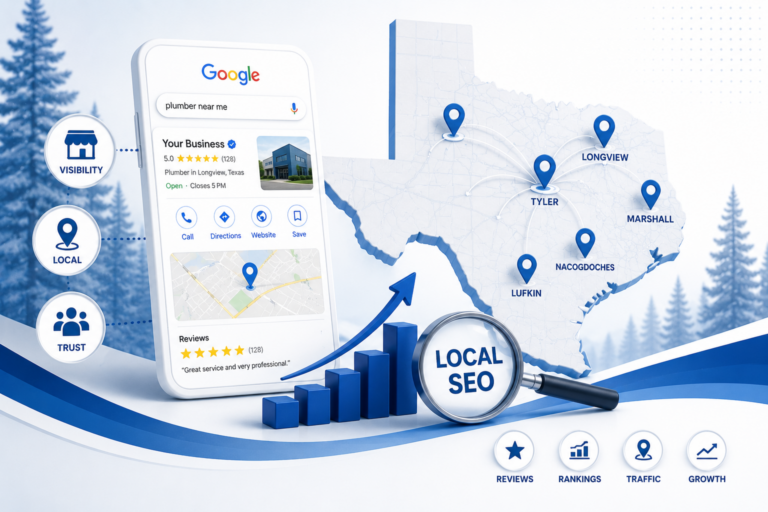
One post, one target phrase. Put it in the title, in the first paragraph, in at least one subheading, and naturally through the body. Not stuffed. Just present. The mistake we see constantly is three posts all chasing the same phrase. They cannibalize each other and none of them ranks. If you already have a post on a topic, improve that post instead of writing a second one. One strong page beats three weak ones. If you want the mechanics behind this, start with what local SEO actually is.3. Link Your Posts to the Pages That Make You Money
This is the step almost everyone skips, and it is the reason blogs that get traffic still produce zero leads. A blog post is the top of the funnel. Somebody reading “How Much Does a Website Cost” is close to buying, but only if you hand them the next step. Every post should link to the service page that matches it. Every post should end with a phone number. Those internal links do double duty. They move readers toward a sale, and they pass authority to your money pages, which helps those pages rank. It costs you nothing and most of your competitors do not bother. We cover this in more depth in how a business blog feeds local SEO.4. Push Every Post Out. Do Not Wait for Google
Search traffic takes months to build. In the meantime, you have an audience you already own, so use it.- Email it. Your customer list is the highest-converting audience you have. One short email, one link, one sentence about why it matters.
- Post it to Facebook and your Google Business Profile. Do not just drop the link. Pull the single most useful sentence out of the post and lead with that.
- Send it to the person who asked. When a customer calls with the exact question your post answers, text them the link. That is the whole point of writing it.
5. Publish on a Schedule and Do Not Stop
One post a month, every month, beats eight posts in a burst and then silence. Google rewards sites that stay alive. Readers do too. Consistency also compounds in a way that surprises people. A post you published in March keeps pulling traffic in November. Twelve of them working at once is a real channel. Three of them from two years ago is not. Be honest about what you can sustain. If once a month is what you can hold, do once a month and hold it.How Long Before Any of This Works?
Email and social traffic show up the day you hit send. Search traffic is slower, usually three to six months before a post starts pulling steady visitors, and it builds from there. Anyone promising faster than that is selling you something. We break the timeline down in how long SEO actually takes. We have been doing this for East Texas businesses since 1999, across more than 300 sites, and the pattern is always the same. The businesses that keep publishing pull ahead of the ones that quit at month three.Want the Blog to Actually Pull Its Weight?
If you would rather run your business than write posts nobody reads, we will handle the topics, the keywords, the writing, and the distribution. Call (936) 225-4705, email [email protected], or request a free quote. We will tell you straight whether a blog is even the right lever for your business, or whether your money is better spent on local SEO first.Why is nobody reading my small business blog?
Almost always because the posts target topics nobody searches for, or because they were published and then never promoted. Write about the questions customers actually ask you, then email and post every article rather than waiting for Google to find it.
How often should a small business blog?
Once a month, held consistently, beats a burst of eight posts followed by silence. Pick a cadence you can sustain for a year and stick to it. Consistency is what compounds.
How long does it take for a blog post to bring in traffic?
Email and social traffic arrive the day you publish. Search traffic typically takes three to six months to build for a new post, then keeps growing. Anyone promising faster search results is not being straight with you.
Do blog posts actually bring in customers, or just readers?
Only if you link them to the pages that sell. A post that answers a question and then points the reader to your service page and your phone number converts. A post that just ends is a dead end.
Should I write about my industry or about my customers' problems?
Your customers' problems, every time. Industry trend posts feel important to write and get almost no searches. The question a customer asked you on the phone this morning is the post that earns traffic.
Is a blog worth it for a small business in Lufkin?
It is if you answer local questions with local intent. Competing on generic national topics is not worth your time. Competing on "how much does this cost in East Texas" is very winnable, because the competition is thin.
Matt Massey
Matt Massey is the owner and lead developer at MasseyMedia. Matt earned a Bachelor’s in Business Management and another in Marketing from the University of Utah. Matt started MasseyMedia during college to pursue his college degree and has been growing the company for over 25+ years.
As a seasoned IT executive, I have spearheaded numerous transformative projects that have streamlined operations, enhanced organizational capabilities, and driven sustainable growth. My expertise spans designing and implementing robust web-based information systems, managing comprehensive IT functions, and leading diverse teams to deliver projects that exceed expectations.
At MasseyMedia, Inc., I have been the driving force behind over 400 successful website launches and numerous IT development projects. My approach integrates strategic planning with hands-on leadership to diversify product offerings and expand business horizons. From introducing advanced hosting solutions to integrating cutting-edge network infrastructure, my focus has always been on leveraging technology to solve complex business challenges.
My career is defined by a passion for technology, a commitment to excellence, and a relentless pursuit of innovative solutions that drive efficiency and competitiveness. I am eager to connect with like-minded professionals and organizations looking for a leader to transform their IT landscapes and guide them through the complexities of modern technology.