
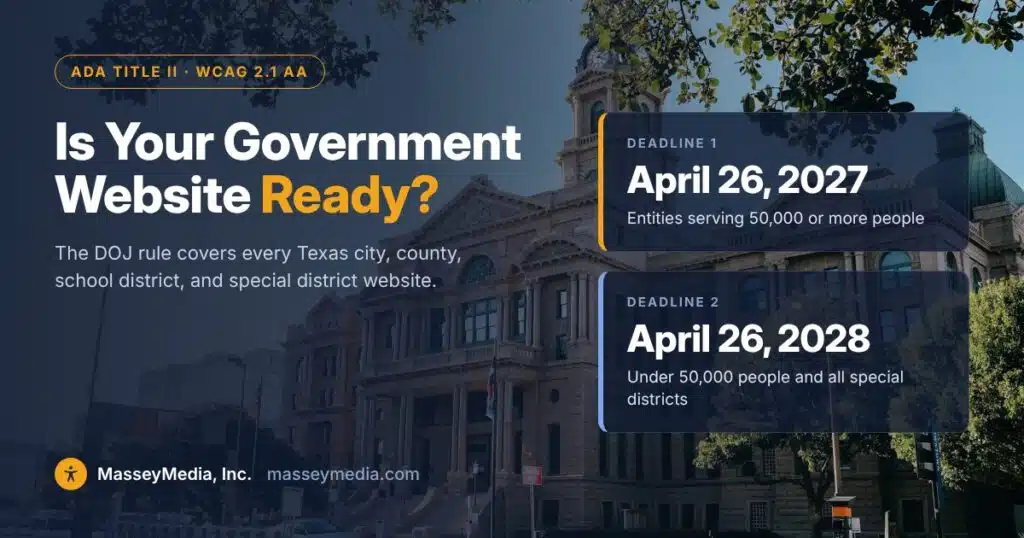
ADA Title II website compliance is now a hard requirement for every Texas city, county, school district, and special district, with real dates attached. The U.S. Department of Justice set the technical standard in 2024, then pushed the deadlines back one year in April 2026. That extension bought public entities time. It didn’t change what the rule demands.
If you run a public-sector website in East Texas, here’s what the rule says, who it covers, and seven steps toward ADA Title II website compliance before your deadline arrives.
What the DOJ Web Accessibility Rule Requires
The DOJ’s Title II web rule requires state and local government websites and mobile apps to meet WCAG 2.1 Level AA. That’s the same international standard courts already use in private-business lawsuits, but for government it’s no longer a best practice. It’s the law, written into the federal code.
In practice, ADA Title II website compliance means meeting WCAG 2.1 AA across every page, form, and document. That covers things like:
- Text alternatives for images, charts, and maps
- Full keyboard access, so nothing requires a mouse
- Color contrast people with low vision can read
- Forms with labels and error messages a screen reader can announce
- Captions on prerecorded video
- Documents, including PDFs, that assistive technology can read
ADA Title II Website Deadline: 2027 or 2028
Your deadline depends on the population you serve, based on Census figures:
- Population of 50,000 or more: April 26, 2027
- Population under 50,000, plus all special district governments: April 26, 2028
In East Texas, that puts a city like Tyler or Longview, and counties like Angelina, Smith, and Gregg, on the 2027 clock. Most smaller cities, ISDs, and utility, hospital, and water districts land on 2028. Two years sounds like a lot until you count the pages, PDFs, and agenda packets on a typical city site. It isn’t.
One more thing about the extension: Title II already required equal access to government services before the 2024 rule existed. A resident who can’t pay a water bill or read a council agenda online can still file a complaint today.
Who Falls Under the Rule
Any state or local government entity with a website or app needs ADA Title II website compliance. In Texas that means:
- Cities and towns
- Counties and county departments
- Public school districts, charter schools, and public colleges
- Special districts: MUDs, water and utility districts, hospital districts, emergency services districts
- Housing authorities, transit agencies, and economic development corporations
It also covers content a vendor provides for you. If residents pay fines through a third-party portal or apply for permits through a hosted form, that portal is your responsibility. “Our vendor built it” isn’t a defense.
7 Steps to ADA Title II Website Compliance
1. Get an Honest Baseline
You can’t fix what you haven’t measured. Every ADA Title II website compliance project should start with a full ADA website audit that combines an automated scan with hands-on keyboard and screen reader testing. Free browser checkers find roughly a third of real problems, which is how departments end up thinking they’re 90% done when they’re closer to 30%.
2. Inventory Your PDFs and Documents
This is where government accessibility audits get ugly. Agendas, minutes, budgets, ordinances, and permit forms pile up for years. The rule has narrow exceptions for archived content and some older documents, but anything residents still use to access a current service has to be accessible. Sort what’s current, what’s archived, and what can come down, then convert the current files into accessible PDFs or plain web pages. A web page is usually easier for residents and cheaper to keep compliant.
3. Fix the High-Traffic Pages First
Bill pay, permits, court information, school enrollment, emergency alerts, and contact forms. If a resident can’t complete those tasks, that’s where complaints start. A good audit ranks every issue by severity, so the worst problems get fixed first.
4. Check Every Vendor Platform
Ask each vendor, in writing, for its current accessibility conformance report (often called a VPAT or ACR). Payment processors, agenda software, job boards, and GIS maps are common trouble spots. Put WCAG 2.1 AA language into every new contract and renewal.
5. Remediate, Then Retest
Fixes include alt text, heading structure, keyboard focus, form labels, contrast, captions, and document tagging. Some sites can be repaired page by page. Others run on a platform so outdated that a website redesign is cheaper than patching it. Either way, retest after the work is done and keep the results. That documentation is your proof of ADA Title II website compliance if a complaint or records request ever comes in.
6. Publish an Accessibility Statement and a Feedback Path
Give residents a clear way to report a barrier and get the information another way while you fix it. It’s good practice, and it shows good faith if a complaint ever lands.
7. Train Staff and Keep It Maintained
The site that passes in March fails in June if the clerk uploads scanned PDFs and the parks department posts flyers as images. Train whoever publishes content, and put the site on a maintenance plan that catches new problems before residents do.
What Government Website Accessibility Costs
Less than people fear, and a lot less than a DOJ complaint. Most Texas city websites and county sites we review have the same short list of repeat problems: missing alt text, untagged PDFs, low-contrast buttons, and forms a screen reader can’t follow. Fix the templates and the repeats disappear across hundreds of pages at once. Our ADA website audit is a flat $500. You get a report of every issue ranked by risk and a plan of attack with a fixed price to fix it. If you hire us to make the changes, that $500 is credited to your final invoice. We audit sites we didn’t build, on any platform, and we’ve built government websites and school district websites across East Texas since 1999.
Start Your ADA Title II Website Compliance Plan Now
ADA Title II website compliance isn’t a one-time project, but the first pass is the hardest. The deadline will feel far off right up until budget season eats the time you planned to use. Get the audit done this fiscal year, so the fixes can go into next year’s budget with a real number attached.
Schedule a consultation, call us at (936) 225-4705, or email [email protected]. We’ll tell you where your site stands and what it’ll take to meet your deadline.
When is the ADA Title II website deadline for Texas cities and counties?
April 26, 2027 for entities serving 50,000 or more people, and April 26, 2028 for smaller entities and all special districts. The DOJ extended both dates by one year in April 2026.
Does ADA Title II website compliance apply to school districts?
Yes. Public school districts, charter schools, and public colleges are state or local government entities and must meet WCAG 2.1 AA under the DOJ web accessibility rule.
Do PDFs have to be accessible?
Any document residents still use to access a current service does. The rule has narrow exceptions for archived content, so sort current files from archived ones and convert current files into accessible PDFs or web pages.
Are we responsible for vendor platforms like payment portals?
Yes. Content a vendor provides on your behalf counts as yours. Ask each vendor for an accessibility conformance report and put WCAG 2.1 AA language into your contracts.
How much does an ADA website audit cost?
MasseyMedia's ADA website audit is a flat $500. If you hire us to make the fixes, the $500 is credited to your final invoice.
Did the 2026 extension change what the rule requires?
No. Only the deadlines moved. The WCAG 2.1 AA standard and everything else in the 2024 rule stayed the same.
Matt Massey
Matt Massey is the owner and lead developer at MasseyMedia. Matt earned a Bachelor’s in Business Management and another in Marketing from the University of Utah. Matt started MasseyMedia during college to pursue his college degree and has been growing the company for over 25+ years.
As a seasoned IT executive, I have spearheaded numerous transformative projects that have streamlined operations, enhanced organizational capabilities, and driven sustainable growth. My expertise spans designing and implementing robust web-based information systems, managing comprehensive IT functions, and leading diverse teams to deliver projects that exceed expectations.
At MasseyMedia, Inc., I have been the driving force behind over 400 successful website launches and numerous IT development projects. My approach integrates strategic planning with hands-on leadership to diversify product offerings and expand business horizons. From introducing advanced hosting solutions to integrating cutting-edge network infrastructure, my focus has always been on leveraging technology to solve complex business challenges.
My career is defined by a passion for technology, a commitment to excellence, and a relentless pursuit of innovative solutions that drive efficiency and competitiveness. I am eager to connect with like-minded professionals and organizations looking for a leader to transform their IT landscapes and guide them through the complexities of modern technology.