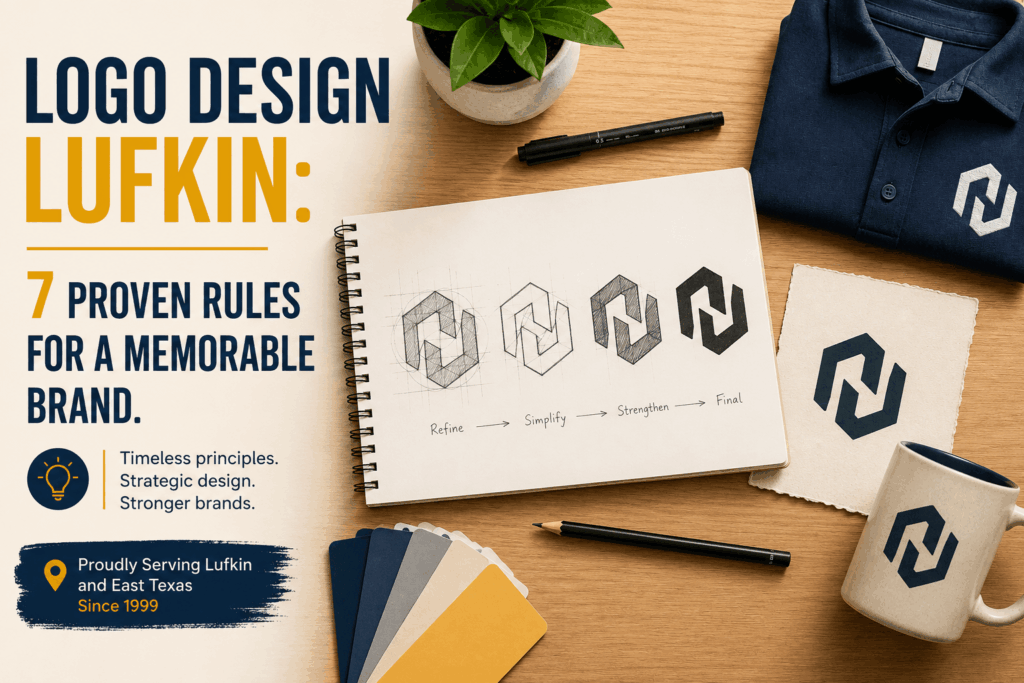
Good logo design in Lufkin is not about winning a design award. It’s about whether a guy driving down Timberland Drive at 45 miles an hour can read your truck door, and whether he still remembers your name two weeks later when his AC quits. That’s the whole job. Most logos in East Texas fail that test.
MasseyMedia has been designing marks for East Texas businesses since 1999, and the mistakes are almost always the same. Too much crammed in. Colors that die on a printed shirt. A file the owner doesn’t actually own. Here are the seven rules we hold every logo to before it goes live.
Why Your Logo Matters More in a Small Market
In Houston, you’re one of ten thousand plumbers. Nobody remembers your logo, and nobody needs to. In Angelina County, there are maybe a dozen serious plumbers, and people talk. Your logo shows up on the same church bulletin, the same rodeo banner, the same Facebook group, over and over, in front of the same few thousand people.
That repetition is a gift, but only if the mark is worth repeating. A muddy, generic logo wastes every impression. A clean one compounds. Ten years of a strong mark in a market this size is worth more than any ad budget you’ll ever have.
Rule 1: It Has to Work at 30 Feet and 30 Pixels
Your logo lives in two extremes. It’s on a yard sign somebody reads from the road, and it’s a tiny circle on a Google Business Profile or a phone screen. Anything that only looks good at 8 inches wide on a monitor is a failed design.
Here’s the test we run: shrink the logo to 32 pixels wide. If it turns into a smudge, it’s too complex. Then print it at 24 inches and stand back. If you can’t read it from across a parking lot, the type is too thin or too tight. A logo that survives both ends is a logo you can actually use.
Rule 2: One Idea, Not Three
The most common request we get is some version of “can we add a pine tree, and a wrench, and maybe the state of Texas?” You can. It’ll look like a bumper sticker.
A logo carries one idea. Pick the single strongest thing about the business and build the mark around that. Everything else lives on the website, in your photos, in your copy. Your logo is the handle, not the whole toolbox.
Rule 3: Pick Colors That Survive a Truck Door
Screen color and real-world color are different animals. A gradient that looks slick on a laptop turns into a blurry mess when it’s cut in vinyl, embroidered on a cap, or screen printed on a shirt. If your business puts its name on trucks, uniforms, or signs, and most East Texas businesses do, the logo has to work in flat, solid color.
Our rule: every logo ships with a full-color version, a one-color black version, and a reversed white version. If it doesn’t hold up in plain black, the design is leaning on color to do work the shape should be doing.
Rule 4: Type Is Half the Logo
For most small businesses, the wordmark is the logo. The icon is optional. That means the typeface choice is not decoration, it’s the design.
Skip the free fonts everyone else in town is using. Skip anything with a hand-drawn, distressed look unless the business genuinely is a barbecue joint or a boot shop. And never let a designer hand you a logo where the letters are just typed out of the box with no spacing work done. Real logo design means adjusting the space between individual letters until the word reads as one shape.
Rule 5: Get the Real Files, or You Don’t Own It
This is the one that costs Lufkin business owners the most money, and almost nobody warns them about it. If all you got from your designer is a JPG or a PNG, you do not have a usable logo. You have a picture of a logo.
You need vector files. Ask for these by name:
- .AI or .EPS — the master vector file, infinitely scalable. Your sign shop and your embroiderer will ask for this.
- .SVG — the vector format your website needs. Sharp on every screen, tiny file size.
- .PNG with transparent background — for slides, social, and quick digital use.
- A one-page brand sheet — your exact color codes (HEX, RGB, CMYK, and Pantone) and font names, so the next vendor gets it right without guessing.
Get all of that in writing, and get full ownership of the design. If a designer won’t release the vector files, walk away. You’ll pay to have it redrawn eventually anyway.
Rule 6: Make Sure It’s Not Already Taken
Before you paint it on a building, spend twenty minutes checking that somebody else isn’t already using it. Run the name and the mark through the USPTO trademark search, then do a plain Google image search. Check the Texas Secretary of State for the business name.
It is a lot cheaper to change course now than after you’ve wrapped three trucks and printed a thousand yard signs.
Rule 7: A Logo Is Not a Brand
A logo is a signature. Your brand is everything the signature is attached to: how your website looks, how fast you answer the phone, whether your invoices look professional, what your shop looks like when a customer walks in.
We’ve watched businesses drop real money on a beautiful mark and then bolt it onto a website that loads in nine seconds and hasn’t been touched since 2019. That doesn’t build a brand, it just puts a nice hat on a problem. The logo is step one of brand development, not the finish line. For the full picture on how the two disciplines differ, read our breakdown of graphic design versus web design in Lufkin.
What Logo Design Costs in Lufkin
Nobody in this market publishes numbers, so here are ours. A straightforward wordmark for a new business, with a handful of concepts, revisions, and the full file package, generally lands in the several-hundred-dollar range. A full brand identity, meaning the mark plus the color system, typography, and a written brand sheet, runs higher because it’s several days of work rather than several hours.
The dollar-store option, a fifty-dollar logo from an overseas marketplace, is usually a stock template that four other companies are also using. We’ve had to redraw more than a few of them. Paying twice is the expensive way to save money.
How MasseyMedia Approaches Logo Design in Lufkin
Our process is short on purpose. We talk about the business, who you serve, and where the logo has to live. We sketch, then come back with a small number of real directions, not twenty half-ideas. You pick one, we refine it, and we hand over the complete file package with the brand sheet. You own all of it.
Because we also build websites, the logo doesn’t arrive as an orphan. It gets designed knowing exactly how it will sit in your site header, your favicon, and your Google Business Profile. See the logo design service in detail, browse our work, or look at how a new mark rolls into a full website design and gets found through local SEO.
MasseyMedia has been designing for East Texas businesses since 1999, out of Lufkin, serving Angelina County and the surrounding region. If you’re ready for a logo people actually remember, call (936) 225-4705 or request a quote. No pressure and no pitch deck, just a straight conversation about what your business needs.
How much does logo design cost in Lufkin?
A straightforward wordmark with concepts, revisions, and the full vector file package generally runs in the several-hundred-dollar range. A complete brand identity, adding the color system, typography, and a written brand sheet, costs more because it takes days rather than hours. Call MasseyMedia at (936) 225-4705 for a firm number on your project.
What files should I get from a logo designer?
At minimum: an .AI or .EPS master vector file, an .SVG for your website, a transparent .PNG, and a brand sheet listing your exact HEX, RGB, CMYK, and Pantone color codes plus font names. If you only receive a JPG or PNG, you don't have a usable logo, you have a picture of one. Get full ownership in writing.
How long does logo design take?
For most East Texas small businesses, about one to two weeks. That covers a short discovery conversation, initial concepts, a round or two of revisions, and final file delivery. A full brand identity takes longer.
Can you redesign my existing logo instead of starting over?
Yes. If the core idea works but the execution is dated or the files are missing, a redraw and refresh is often the smarter move. It keeps the recognition you've already built in Lufkin while fixing the parts that don't hold up.
Do I need a logo before I build my website?
Ideally, yes. The logo sets the color palette and typography the site is built on. If you're starting both at once, MasseyMedia handles them together so the mark is designed knowing exactly where it will live in your header, favicon, and Google Business Profile.
Matt Massey
Matt Massey is the owner and lead developer at MasseyMedia. Matt earned a Bachelor’s in Business Management and another in Marketing from the University of Utah. Matt started MasseyMedia during college to pursue his college degree and has been growing the company for over 25+ years.
As a seasoned IT executive, I have spearheaded numerous transformative projects that have streamlined operations, enhanced organizational capabilities, and driven sustainable growth. My expertise spans designing and implementing robust web-based information systems, managing comprehensive IT functions, and leading diverse teams to deliver projects that exceed expectations.
At MasseyMedia, Inc., I have been the driving force behind over 400 successful website launches and numerous IT development projects. My approach integrates strategic planning with hands-on leadership to diversify product offerings and expand business horizons. From introducing advanced hosting solutions to integrating cutting-edge network infrastructure, my focus has always been on leveraging technology to solve complex business challenges.
My career is defined by a passion for technology, a commitment to excellence, and a relentless pursuit of innovative solutions that drive efficiency and competitiveness. I am eager to connect with like-minded professionals and organizations looking for a leader to transform their IT landscapes and guide them through the complexities of modern technology.